 For the uninitiated, cloud computing – or at least the jargon surrounding cloud computing – can be as confusing as a trip to Baskin-Robbins for someone who’s never had ice cream.
And, while there aren’t quite 31 flavors of cloud, choosing which variety suits you best can be a challenge.
One of the best things about today’s emerging new class of Cloud Management Platforms is that you are no longer limited to just one flavor – public, private or hybrid. It’s now possible to mix and match the cloud types that suit your various business needs and requirements and to manage them all from one screen.
But still, it’s helpful to have some understanding of the current trends surrounding cloud computing, especially as more vendors lay out confusingly titled options. Following is a quick synopsis of some key trends, as well as terms that are helpful to understand as you shop around. Continue Reading…
 This is an amazing time in cloud computing. Recently, we’ve seen dramatic reductions in the price of public cloud with Google and Amazon engaged in a high-stakes arms race to the bottom. How low can they go?
First came Google, with price cuts ranging from 32 percent for compute to 68 percent for storage. Back came Amazon, with reductions of 30-40 percent for compute and 51 percent, on average, for storage.
As Infoworld cloud computing blogger David Linthicum wrote, the two largest public cloud vendors are like a couple of carnival barkers, “standing on the sides of the strand, shouting out lower and lower prices for their services of luring major enterprises to their tents.” Continue Reading…
 The constantly evolving dictionary of IT terms had a new entry in the past year or so: Software-Defined Networking. In short order, SDN has threatened to become one of the most important terms of 2014.
Here’s why: For a variety of reasons, large enterprises are relatively late to the cloud party and all the benefits that are possible, from reduced capital and operating expenses to elastic capacity for innovation. Now, the pressure is on IT to transform from organizational obstacle to facilitator of innovation – without losing governance.
SDN, which you’ll see referred to alongside sister terms Software-Defined Data Center and Software-Defined Storage, helps provide an answer to that need. Continue Reading…
 The health care industry has faced some specific barriers to full adoption of cloud computing. A primary barrier is the Health Insurance Portability and Accountability act, or HIPAA.
Every health care professional knows the implications of HIPAA, which not only required the establishment of electronic health records (EHRs) but also mandated stringent regulations on data privacy.
In effect, the law mandated a huge expansion in health care computing needs (by requiring EHRs), while at the same time blocking an easy path to meeting those needs in the public cloud (by threatening heavy fines for privacy violations).
Most institutions were simply not willing to trust data security to the public cloud. Even with encryption and other barriers, data breaches and security failures remain all too common. And, if a breach occurs, it’s the health care provider – not the cloud provider – who’s on the HIPAA hook. Continue Reading…
 The other day, someone asked me a question that cuts right to the core of Connectloud’s existence and why uCloudTM is such a leap forward for Enterprise CIOs in all industries: What takes companies so long to stand up a private cloud through legacy implementation, and what allows uCloudTM to do it so much faster?
The answer is why we at Connectloud left our previous jobs to start a new company – to change tech, to provide CIOs what they have been asking for.
To start with, cloud management platforms – the tools we used to stand up clouds – were mostly an afterthought until now. What folks have done is stitch together legacy software applications and called them cloud management platforms. Continue Reading…
 One of the most basic principles underlying the modern concept of cloud computing is an age-old idea: sharing.
When big, room-sized mainframe computers emerged in the 1950s, they cost so much that making efficient use of them was at a premium. Machines with no computing power of their own (called “thin clients”) were used to tap into the mainframe’s computing power simultaneously.
The more things change, the more they stay the same.
The same concept underlying the old idea of “time sharing” is at work today in what’s called “multi-tenancy.” In the context of cloud computing, this refers to sharing one instance of a software application. Continue Reading…
Happy Friday, everyone!
We hope you’ve never experienced Public Cloud Sticker Shock — and that you never do.
Thanks for reading our blog, and have a great weekend!
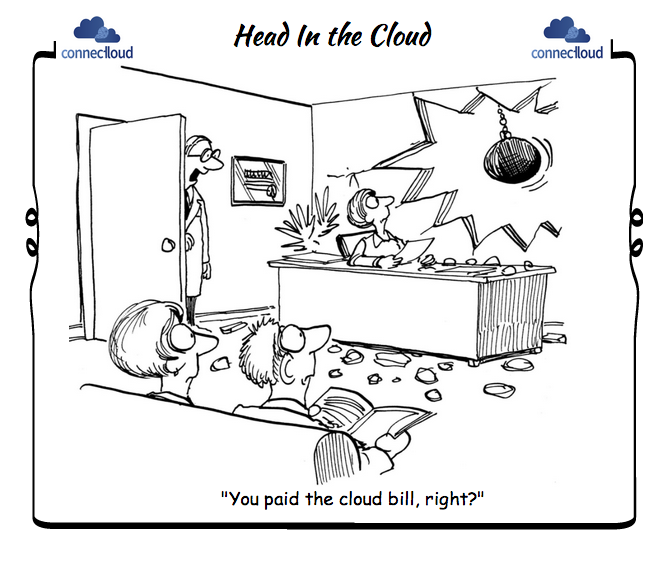
 There’s an old story about when Sherlock Holmes and his assistant, Watson, went camping. It’s the middle of the night. Holmes nudges Watson: “Look up at the sky and tell me what you deduce.”
Watson looks up and comments on the starry sky. He observes there must be billions of stars and planets. Astrologically, Saturn is in Leo. He deduces by the stars that the time must be about a quarter past three. The sky is clear, so he guesses it won’t rain.
He then asks, “My friend, Holmes, what do you see?” To which the wise fictional detective responds: “Watson, you fool. Someone has stolen our tent!”
In the same way Watson missed the forest for the trees, enterprises might not understand their current predicament regarding the cloud. When you take a look at what they’re actually operating, it’s easy to see they don’t embody what experts think of as a private cloud, and they’re not getting the full benefits as a result. Continue Reading…
Building anything can be a challenge filled with pitfalls you can see and minefields you can’t. The construction of a private or hybrid cloud for your enterprise is no different.
Sure, the private cloud offers lots of benefits, from cost savings to greater efficiency and increased data security across your organization.
 But if you don’t watch your step, it’s easy to walk smack into buying costly technology that doesn’t meet your expectations. It’s also quite feasible to set expectations too high internally, leading to disappointment and slashed budgets in the future.
The analysts at Forrester Research have issued some handy guidelines to enterprises interested in setting up a private cloud – an option now within reach for an increasing number of companies through an emerging class of cloud management platforms.
Here’s a list of some do’s and don’ts when delving into the cloud, according to the folks at Forrester: Continue Reading…
A big reason why companies are using virtualization is to make more efficient use of hardware such as servers. So-called “virtual machines” – meaning software programs that emulate how given pieces of hardware work – essentially allow one set of hardware to do several jobs at once on many different machines.
 Now, a relatively new approach promises to bring this same basic idea to networks that carry phone calls, data and video. It is being billed as the largest disruption to the way computer networks are designed and operated since the introduction of TCP/IP paradigm more than two decades ago.
Software-defined networking, or SDN for short, allows a central software program (rather than hardware) control networks that move the data, video and phone calls from one place to another. A somewhat more technical definition is that SDN separates what’s known as the “data plane” – the part of the network that moves data packets – from the “control plane,” which handles jobs like routing traffic and configuring and operating the network.
This is vital for cloud computing because the emerging field of SDN may make it less expensive – and faster – to build networks that carry large amounts of traffic. Continue Reading…